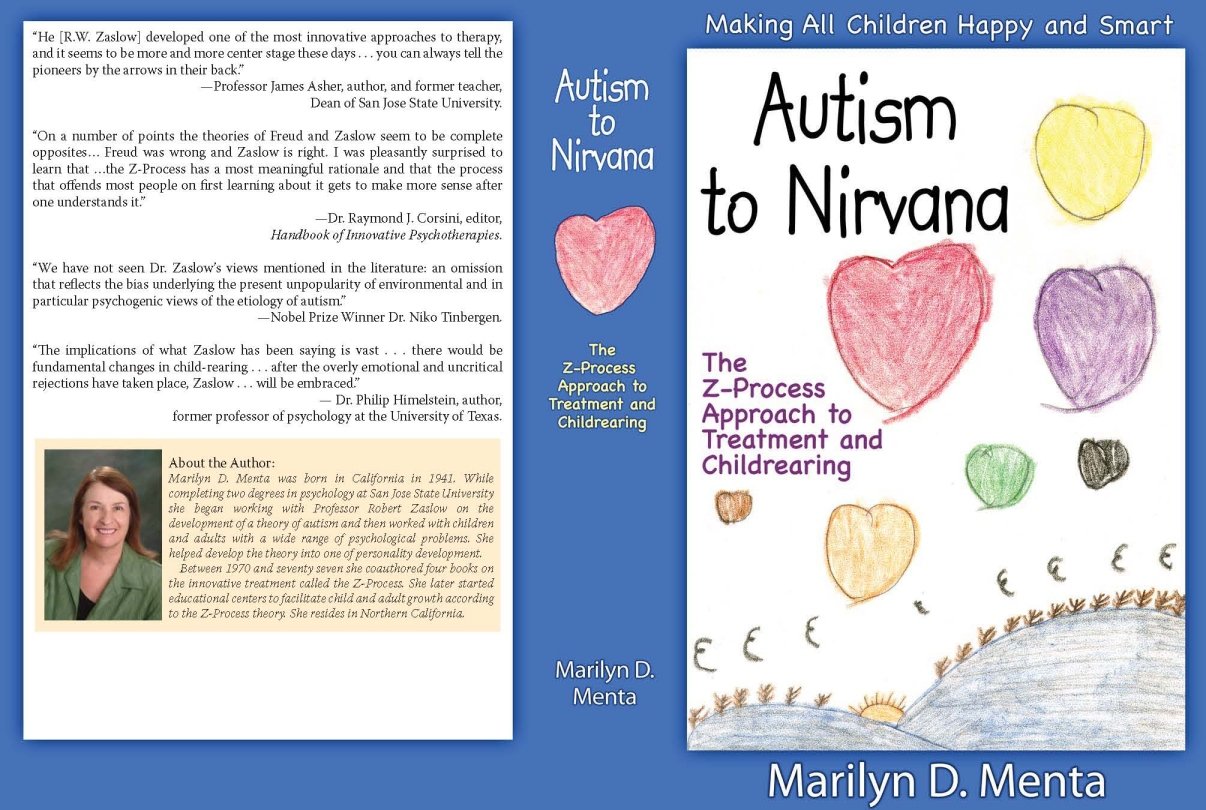
| Book Excerpts:
The psychology professor and clinical psychologist Dr. Robert Zaslow was concerned that American culture had become confused about the process of socializing and handling aggression. Working together we began to forge a theory of personality based on an understanding of the stages of psychological growth. We began in a logical manner to explore the Autonomic Nervous System, which is Freud's Id, the part of our bodies which is outside of our conscious control, we proceeded to influence this bodily system by using psychological methods including physical holding.
To raise our children well from the very beginning we must start at the onset of the relationship between parents and children and learn all we can about the nature of bonds. In order to understand bonding we will explore the nature of autism.
It is not only the science of human attachment that is to be analyzed; my book is about people and a way they can learn from others, and survive and thrive.
While there is a lot of readable theory in this book it is supported by countless true stories of children and adults.
Chapter 24 Doctor Elvis: The Z-Process Goes to Hollywood.
As I told you earlier, after Robert's demonstration treating two behavior problems boys in Los Angeles, when he first met with Renae Granis of the Los Angeles School District, two other men in the audience came up to him and engaged in a conversation which would lead to the second project -- a Hollywood movie starring Elvis Presley.
The first man, Joe Connelly, introduced himself in a jovial manner as a movie producer who said he was writing a script about Catholic nuns working with autistic children. He was known for producing the Lassie series on television. His friend, a Catholic Priest, came along with him to give his impressions of the rage reduction therapy.
Both men were enthusiastic about what they'd seen and Joe said to Robert, "Did you see the kid flipping us all off when he was brought in for the session? I'd have bet you couldn't have turned him around, but you did!" Mr. Connelly thought that what he had witnessed showed a "masculine" approach to mental health, unlike other method's he's researched which seemed too mechanical or too soft.
Joe seemed to feel that casting the King of Rock as a doctor treating autistic inner city children needed an explanation. Elvis, he said, wants to change his image. He wanted to become a real actor and the movie was going to be a turning point in his life. Why not have Elvis play a doctor, I thought? He didn't look like your typical practitioner, but neither did Robert who had a striking resemblance to Zorba the Greek. As it turned out, working on the movie was a very emotional experience where events got out of control due to poor management on the set. But this did not happen with Elvis, who did a superb job both on and off the camera.
Chapter 25 "Off the Pill" dramatically illustrates the harmful role that drugs played in a child's life before the Z- Process turned him around. A film presentation by Robert Schuyler of a schizophrenic hyperactive 12-year old that underwent the treatment was given at the Western Psychological Convention. In this chapter, Robert interviews this child's mother, showing the lengths some parents will go to to alleviate the stress of their severely disturbed children and how gratified they are with success. This case also demonstrates the speed at which a good therapeutic program can turn around very severe problem children.
Chapter 26 presents a double blind experiment conducted at Long Beach State University showing the dramatic changes in the reduction of hyperactivity conducted by the mothers in a two-week period.
Over 150 adults underwent lengthy Z-Process holding session.
Following his seven hour holding session, this 21 year old student wrote about his experience:
| |
"Life began for me only a month ago. Having a rage reduction was the turning point between mere existence and the rewards of a fuller
life. All my life I had been building a wall around myself and
isolating myself from others.....
|
The second "growth experience" is a five year follow-up interview from a thirty year teacher who underwent a 10 hour Z-Process as a student.
Sadies Interview:
Robert: How old are you now?
S.: I turned thirty last month.
R. You look as charming and beautiful as ever.
S. Thank you.
R: How long ago did we work together?
S: Five or six years.
R. Do you remember why you wanted a session?
S. Well, at the time I was unhappy in a lot of ways. I wasn't
making it with men at all.
R. What do you think the trouble was?
S. Really deep down I don't think I liked men and I felt afraid
of them, like I couldn't handle them.
R. So that you really didn't feel comfortable with men or
statisfied with the way you were?
S. No. I maintained really superficial relationships with them.
R. So it was not profitable or emotionally significant
or satisfied with the way you were?
S. No, I maintained really superficial relationships with them.
R: So it was not profitable or emotionally significant?
S. No.
R. Anything else you had in mind when we had a session?
S: I was very forgetful. I couldn't really remember things. I would let people down a lot.
.................
M: So could you just sort of summarize the physical changes before
and after the session.....
S: Well, before the session I had a lot of tension in my throat.
I had a lot of sore throats. I always felt like I had a lump in
my throat and I think I had a very tense body - very nervous hands and feet, you know, wiggly. I think I had a very rigid posture, and I was sexually unresponsive to men.
|